Monday, May 14, 2012

Vi Veri Veniversum Vivus Vici - By the Power of Truth, I, While Living, Have Conquered the Universe


Ai Weiwei uses art as a form of social activism.  It is his means of expression and political voice.  Being from China, political voice and expression is something that is a rather limited commodity.  His works range from the politically neutral to the extremely controversial.  One of his most controversial works was titled “So Sorry” and exhibited at Haus der Kunst, in Munich, Germany in 2009.  In the work, he created a massive billboard, in essence, out of children’s school bags.  The 9000 bags were arranged in such way that they spelled out “She lived happily on this earth for seven years.”  The work was a response to the numerous schools that collapsed following an earthquake in China that resulted in the death of countless children.  The controversy is not due to the effects of the quake itself, but rather because the buildings surrounding the schools largely remained standing.  It was clear that the schools had been constructed with inferior materials; moreover, upon their collapse, it was almost impossible to find any remains; the government quickly covered up the incidents and parents to this day do not have closure, forced to bury empty caskets.  Parents are never supposed to bury their children, and for a government to so shamelessly discard the grief of hundreds of parents and discard their outcries is wrong on a fundamental level.
 Ai Weiwei’s work is a giant and vivid reminder to the government of what they have done as well as a symbolic ‘fuck you’.  He, through his work of art, is calling out the government of China on what they have done, and he’s doing it extremely publicly.  In a land where people disappear every day for asking too many questions, Ai Weiwei is taking some extreme risks through his art.  He said the following about the work: 
"The idea to use backpacks came from my visit to Sichuan after the earthquake in May 2008.  During the earthquake many schools collapsed.  Thousands of young students lost their lives, and you could see bags and study material everywhere.  Then you realize individual life, media, and the lives of the students are serving very different purposes.  The lives of the students disappeared within the state propaganda, and very soon everybody will forget everything.”
His remarks make him a target.  His being outspoken puts his own life in peril.  His being an activist through his art makes him essential.

Ex Glande Quercus - From Acorn to Oak


Art is extremely unique in its ability to tell a story.  It needs not any visual aids, or embellishments; the works speak for themselves.  The story, in most cases, is whatever the viewer interprets the work as; it may be exactly what the artist was attempting to express, or it may be something completely different.  In either case, if the work manages to incite in the viewer’s imagination some form of tale, it has done its duty. 
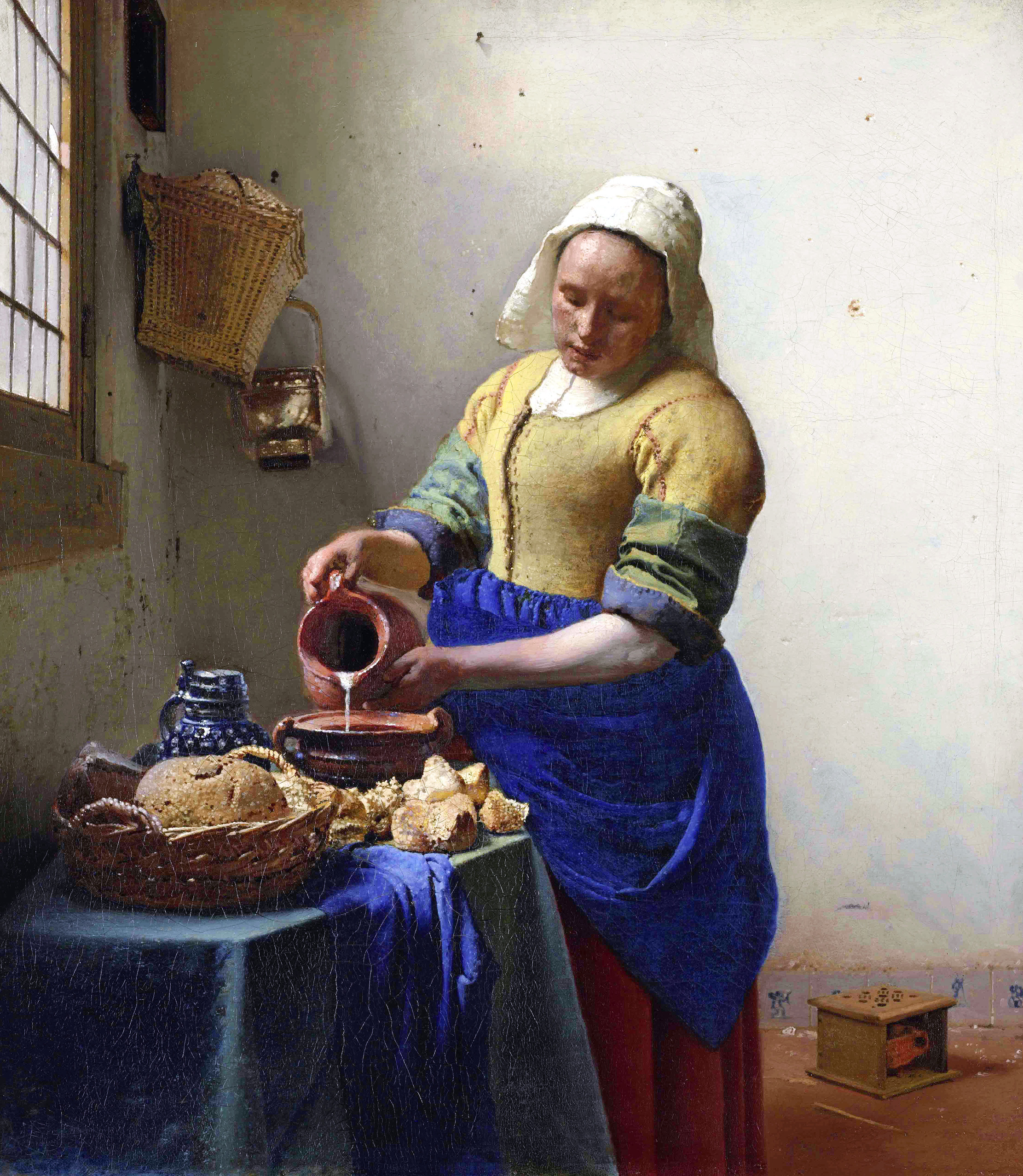
The Milkmaid by Vermeer
Take the image adjacent, for instance.  To me, it tells the story, at least in part, of this woman’s life.  Her role in society; her class in the hierarchical system.  I would say she is not a poor woman, given the wealth of clothing she is wearing and their different colours, suggesting an ability to afford various colours of fabric.  Moreover, she is not overly skinny, suggesting enough wealth to afford food; also, her complexion is rather pale, indicating she does not do menial work in the fields.  That said, I wouldn’t classify her as part of the aristocracy, given the apparent conditions of the walls and floor, as well as the fact that she is performing such a task.  No, rather I would assume she is the servant of someone of affluence and of means.  The room she is in could be either her quarters in a much more grand establishment, or her own home.  She appears to be preparing an evening meal based on the fading light protruding from window.  I would also guess that she is French; for what reasons, I do not know – it’s what the image conveys to me. 
Her expression seems fixated on the task at hand, but also on the future.  There is a slight sense of apprehension visible in her face.  She is worried, but tempts to mask this by burying herself in her duties.  Or perhaps she is masking sorrow or loss.  The use of shadow to the right of the image surrounding her face creates ambiguous mystery.  Uncertainty as to what they day may hold.
Any piece of art can bring forth a wealth of possible tales.  It all depends on one’s mindset and imagination.  Personally, I see things objectively, so the story I see unfold is merely a reflection of the events taking place in the picture at the moment.  An analysis of the image is the story to me.  But that’s me; how about you?